Keyword Research in 2026, a Baby-Step Walkthrough (With a Librarian, a Robot, and a Treasure Map)


Keyword research is figuring out what people whisper to the Librarian so your “book” gets handed to them.
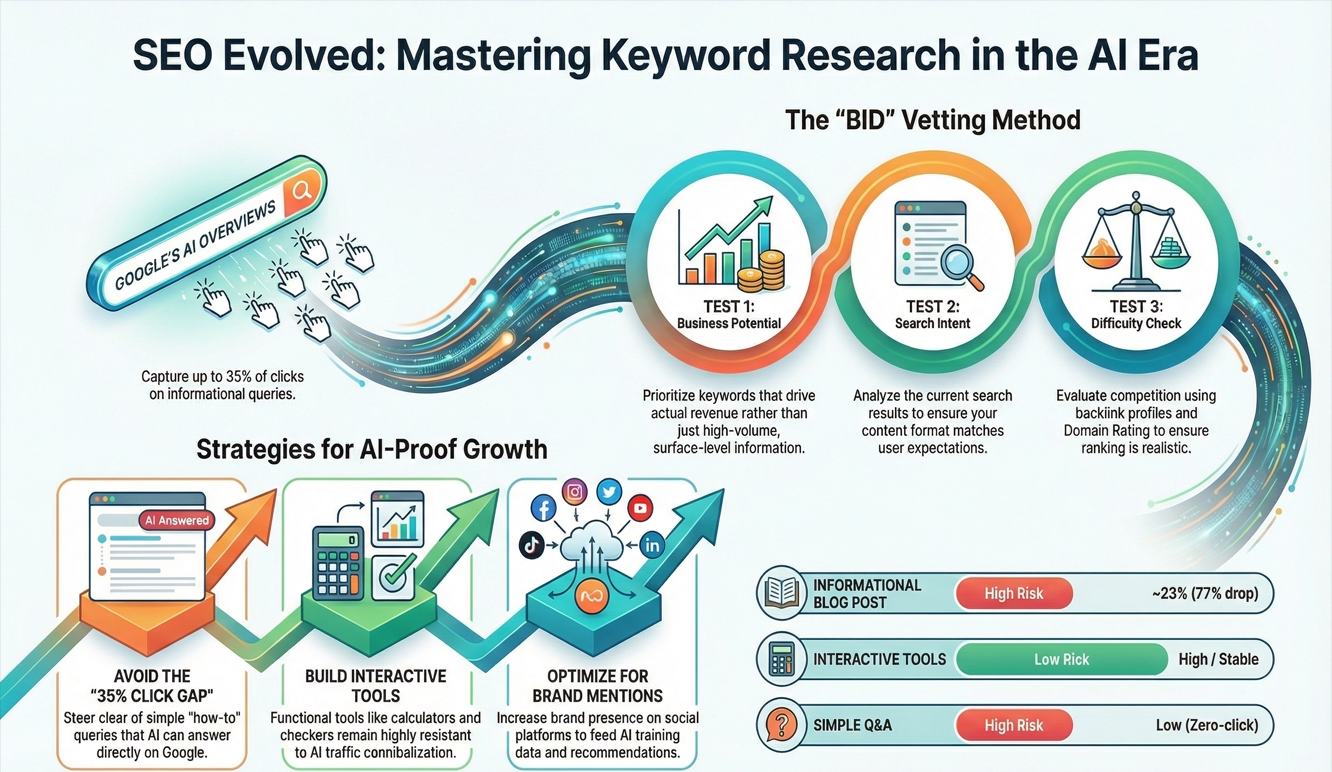
But now the Librarian has a robot assistant. Sometimes the robot answers right there at the desk, and the visitor walks away without opening any book. In Google, that’s what AI Overviews often do, and multiple studies have shown meaningful click drops on informational searches when an AI Overview appears.
So the game is not “rank for a ton of keywords.”
The game is:
- Find the whispers that still lead to clicks, leads, and sales.
- Create pages the robot cannot fully replace.
- Build enough brand presence that the robot quotes you anyway.
This tutorial is written so a beginner can follow it like LEGO instructions.
You will end with a clean keyword list, a simple scoring system, and a content plan that still works even when AI answers show up.
What you need to rank higher on google (keep it simple)
Tools (pick one option per line):
- A place to organize keywords: Google Sheets or Excel
- A “word magnifying glass” keyword tool: Ahrefs, Semrush, or a free combo (Google Autocomplete + People Also Ask + Keyword Planner)
- A browser window, ideally Incognito/Private mode for unbiased searching
Time: 60 to 120 minutes for your first real list.
Rule #1: You are not collecting words. You are collecting buyer situations.
The new reality, in one minute
In 2026, Google often shows AI summaries (AI Overviews) and also experiments with more chat-style experiences (AI Mode). Some publishers have seen lower click-through rates on classic blue links, especially for non-branded informational queries.
One Ahrefs study found that when an AI Overview was present, the top-ranking page’s CTR was about 34.5% lower (correlation-based analysis on a large keyword set).
Important skepticism check: that does not mean “SEO is dead.” It means “informational, easy-answer queries are riskier.”
Your job is to sort keywords into two buckets:
- Robot-friendly queries: the answer is short, generic, and easy to summarize.
- Click-worthy queries: the answer depends on context, comparison, tools, steps, local details, pricing, or real proof.
You want to focus on the second bucket first.
Step 0, pick your “money path” before you pick keywords
Most beginners skip this, then wonder why traffic doesn’t pay rent.
Answer this with one sentence:
“If someone finds my site, the main way I make money is…”
- getting booked calls
- selling a product
- affiliate links
- ads revenue
- email list, then selling later
- local foot traffic
Why it matters: “Best espresso machine under $500” makes sense for affiliate sales. “Espresso definition” usually doesn’t.
Step 1, The Seed and the Flavour (Your Hero Prompt)
1A) Seed keywords, the plain cake
Seeds are broad topics, like:
- “coffee”
- “espresso”
- “home roasting”
They are not your final keywords. They are ingredients.
1B) Modifiers, the frosting
Modifiers make the seed specific, like:
- best, top, vs
- under $500
- for beginners
- near me
- calculator, template, checklist
- cost, pricing
- how long, how much
1C) The “Hero Prompt” you give an AI assistant
Copy-paste and fill the blanks:
Prompt
I run a business called: [X].
I sell: [Y].
My ideal customer is: [Z].
They usually struggle with: [3 problems].
Give me:
- 15 seed keywords (broad topics) my customers care about.
- 20 modifiers that show strong intent to buy, book, or take action.
- 30 long-tail keyword ideas combining seeds + modifiers.
Format it in 3 lists.
Example (coffee niche)
- Seeds: espresso machine, grinder, coffee beans, milk frother, latte art
- Modifiers: under $500, for beginners, quiet, small kitchen, easy to clean, vs
- Long tails: “best espresso machine under $500 for beginners”, “quiet coffee grinder for apartment”
Baby-step tip: If the AI gives you messy results, ask it to remove duplicates and group by intent (buy vs learn vs compare).
Step 2, Grow your list (The Multiplier)
Now you feed your seeds into a keyword tool so it can show you real phrases people type.
Option A: Using a keyword tool (Ahrefs/Semrush style)
Basic workflow is usually:
- Open the tool’s keyword explorer
- Paste 5 to 15 seeds
- Choose your country and language
- Click “match terms” or “related keywords”
- Export the list
What you are looking for:
- long phrases (usually easier)
- clear intent words (best, price, near me, template, calculator, vs)
- questions that suggest a real problem, not trivia
Option B: The free method (still works)
Use Google itself like a metal detector:
- Type a seed in Google
- Note the Autocomplete suggestions
- Scroll to “People also ask”
- Scroll to “Related searches”
- Repeat with a modifier added
Example:
- “espresso machine”
- “espresso machine under 500”
- “espresso machine under 500 canada”
- “espresso machine under 500 for beginners”
Baby-step tip: Make a simple sheet tab called “Raw Dump” and paste everything there without thinking.
Thinking comes next.
Step 3, Clean and label (Turn the pile into a map)
You now have a pile of “search whispers.” You need labels, like putting books on the right shelves.
Create columns like this:
- Keyword
- Intent type (pick one):
- Learn (informational)
- Compare
- Buy/Book (transactional)
- Local
- Tool/Template
- What they really want (in plain English)
- Business potential (0 to 3)
- Difficulty (0 to 100 if your tool gives it)
- AI risk (Low, Medium, High)
- Best page type (blog, landing page, tool, calculator, category page)
- Notes
How to label “what they really want”
Pretend the searcher is texting a friend:
- “best espresso machine under $500”
→ “I want to buy, help me choose one fast.” - “how to make espresso”
→ “I’m stuck, teach me the steps.” - “espresso machine repair montreal”
→ “I need a local service now.”
This line is the secret. It makes content writing easy later.
Step 4, The BID Method (Your anti-trap filter)
You already have the right idea. Let’s make it even more usable.
B, Business Potential
Ask: “If I rank #1, does this help me make money?”
Score it:
- 3 = directly makes money (book, buy, quote, pricing, near me)
- 2 = strong pre-buy research (best, vs, reviews, comparisons)
- 1 = top-of-funnel learning (how to, what is)
- 0 = curiosity, school-style definition, trivia
Example
- “best espresso machine under $500” = 3
- “espresso vs cappuccino” = 1 or 2 depending on your business
- “what is espresso” = 0 or 1
I, Intent match
This is where beginners lose.
Do a real Google search and look at page 1:
- If page 1 is full of product pages and ecommerce, Google thinks the visitor wants to buy.
- If page 1 is guides and videos, Google thinks the visitor wants to learn.
- If page 1 is local map results, Google thinks the visitor wants a nearby provider.
If your planned page type does not match what’s already winning, your chances drop hard.
D, Difficulty
Difficulty is basically “how hard is it to beat the current winners.”
Baby-step checklist:
- Are the top results huge brands (Amazon, Wikipedia, government, mega publishers)?
- Do they have strong backlinks and deep content?
- Does the keyword tool show high difficulty?
If yes, either:
- go longer tail, or
- create a tool/template angle, or
- choose a more specific niche
Step 4.5, Add one new letter: T for “Triggers AI answers”
This is the 2026 upgrade.
Search your keyword in Incognito and ask:
- Do you see an AI Overview at the top?
- Do you see a featured snippet or “quick answer” box?
- Does the result look like Google can answer without clicks?
Why this matters: AI Overviews have been associated with significant CTR drops for informational queries.
Score AI risk:
- High: definition-style, simple how-to, common questions
- Medium: comparisons, some nuance
- Low: local, pricing, tools, calculators, quotes, “near me,” real product fit
You do not have to avoid High risk keywords forever.
You just should not build your whole business on them.
Step 5, The AI-proof move, build something you can “use,” not just read
A skeptical objection: “AI can do things now, not just explain.” True, AI is getting more action-oriented.
But most businesses still win by creating assets that:
- produce personalized outputs
- require inputs (numbers, location, preferences)
- are hard to summarize in one generic paragraph
- capture leads, emails, or bookings
Also, Google is still trying to show and improve links inside AI experiences, which suggests it still needs the open web, but you cannot rely on “informational clicks” the same way.
Tool ideas by business type (steal these patterns)
Service business
- “Project cost estimator”
- “Timeline calculator”
- “Checklist before you hire a [profession]”
- “Quote builder”
- “Emergency decision tree”
Ecommerce
- “Finder quiz” (pick the right product)
- “Size calculator”
- “Comparison table generator”
- “Bundle builder”
B2B
- “ROI calculator”
- “Audit scorecard”
- “Template library”
- “Policy generator”
- “Requirements checklist”
Coffee niche
- “Espresso shot timer”
- “Grind size troubleshooting wizard”
- “Machine selector quiz under $500”
One good tool can outperform dozens of generic articles because it gives immediate value and creates a reason to click.
Step 6, Become a “known name,” so AI mentions you on its own
You wrote: “AI learns by reading conversations.” Directionally true.
The practical version for a beginner is:
- Give people a simple way to talk about you and reference you.
- Create one thing worth citing, like a study, a benchmark, a template, a calculator, a unique dataset, or a very clear framework.
- Get it shared in places where people actually discuss your category.
Skeptical check: you do not need to “go viral.” You need repeated, relevant mentions in the right pockets.
Also, even Google is adjusting how it shows sources and links in AI answers, which means being a cited source matters.
A full follow-along example (from zero to a real plan)
Let’s pretend you are a local service business: a residential electrician in Montreal.
Step A) Seeds
- electrician
- panel upgrade
- EV charger
- electrical inspection
- recessed lighting
Step B) Modifiers
- cost, price, quote
- near me, montreal
- licensed, certified
- permit
- timeline
- best, recommended
Step C) Multiplier outputs (example keywords)
- “ev charger installation cost montreal”
- “electrical panel upgrade cost”
- “electrician for condo renovation montreal”
- “do i need a permit to install ev charger quebec”
- “200 amp panel upgrade time”
Step D) BID + T scoring
Take “ev charger installation cost montreal”
- Business potential: 3
- Intent: visitor wants pricing and service provider
- Difficulty: medium (often local competitors)
- AI risk: low to medium (local, pricing, quote)
- Best page type: landing page + quote form + cost ranges + factors
Take “what is an electrical panel”
- Business potential: 1
- Intent: learn
- AI risk: high
- Best page type: only write if it supports topical authority and internal linking, do not bet the business on it
Step E) Final output plan
- 3 money pages (quotes, pricing, local services)
- 2 comparison pages (options, “best for X”)
- 1 tool (cost estimator or checklist)
- 6 supporting articles that funnel into the money pages
That is a business-first keyword strategy.
Not a traffic hobby.
Your “first 10 keywords” starter rule (works in almost every niche)
For your first batch, try to pick keywords that include at least one of these:
- cost, pricing, quote
- near me, [city]
- best, top
- vs, compare
- calculator, template, checklist
- for [specific audience]
- under [$], within [time]
These tend to have:
- clearer intent
- higher business potential
- lower AI “instant answer” risk
Common beginner mistakes (so you can avoid them)
- Chasing only high volume. High volume often means high competition and high AI answer risk.
- Ignoring intent. If Google is serving product pages and you publish a long story, you will struggle.
- Publishing 20 articles with no funnel. Each piece should lead somewhere valuable.
- Targeting “definition keywords” as your main strategy. AI Overviews are especially common on informational intent keywords.
- Thinking difficulty scores are truth. They’re useful, but you still have to look at the actual results.
A simple 7-day execution plan (baby steps)
Day 1: Write your money path sentence, generate seeds + modifiers with the Hero Prompt.
Day 2: Expand keywords with your tool or free method, dump into a sheet.
Day 3: Label intent and “what they really want.”
Day 4: Apply BID scoring, delete low business potential.
Day 5: Check AI risk (T), mark High risk keywords clearly.
Day 6: Choose 3 money pages, 2 comparison pages, 1 tool idea.
Day 7: Write outlines for those 6 assets, each with one clear CTA.
Final thought (the mindset that wins now)
Old SEO was like writing the best encyclopedia entry.
New SEO is like building the best workshop:
- some explanations, yes
- but also calculators, checklists, templates, demos, proof, and next steps
That is what keeps you valuable when the Librarian’s robot gets smarter.
We define clear objectives, map the shortest path to results, and design systems that remove friction at every step. Every decision is justified, measured, and aligned with conversion, not opinion.
We adopt innovations only when they create real leverage. New tools, methods, or technologies earn their place by improving performance, speed, or clarity, never by trend.
We translate business goals into executable digital systems that support growth, intake, and positioning. The strategy is built to compound over time, not to impress in a deck.